Problem Overview
 | |
| Figure 1. Lycopodium spores (60 um) captured on 0.5 um diameter fibers. [3] |
Filtering has a countless number of applications in modern day society. Filtering is used to separate harmful substances for clean and useful ones based off of particle size. Filtering is also used to separate weak particles from stronger ones. Through electrospinning various types of PEO solutions, our group intends on experimenting with various variables during the process to create a strong, yet thin fiber that can be used for filtration purposes. By creating durable fibers, a preliminary filter can be tested to see which can separate certain particles and still be useful in the long run. The picture on the right shows Lycopodium club moss spores (diameter about 60 micrometers) being captured on an electrospun polyvinyl alcohol fiber. If these spores were to get inside a human body, they would cause severe sickness and potentially do major harm to the body. A perfect application for the fibers spun would be to design and create a water filtration device to avoid this type of sickness from even occurring.
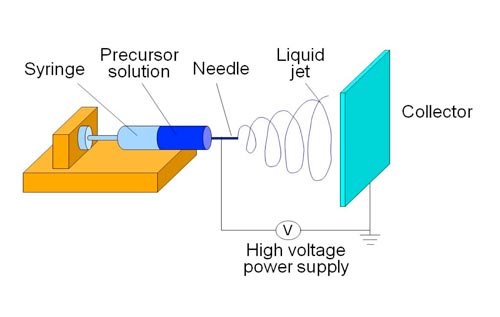 |
| Figure 2. Electrospinning apparatus |
Figure 2 shows the electrospinning apparatus and how it works. The PEO solution sits inside of the syringe at room temperature and the solution slowly comes out of the tip of the syringe. A very high voltage supply causes the liquid solution, in our case, PEO, to liquid jet onto a collecting plate. We will be using a similar apparatus seen here.
Design Goal
The goal of our design is to test PEO under various variables and see under which conditions does the spinning give the best fibers. The ideal fibers we are looking for that will give the best filtering effect must be strong and be small to medium in diameter length. A relatively decent diameter length is 0.5 to 1.0 micrometers [7]. We will be testing the strength of the fibers by using various strength tests and tenacity measurements through a tension meter. Small fibers will allow for maximum filtration and will only let water molecules and things smaller than water to pass through the fiber-wire filter. Current existing designs have large gaps between the fibers/wires which allows for larger and more harmful particles to pass through. Our design will eliminate this because we plan to research what are the frequent harmful molecules in water and compare there sizes to see how small our fiber filter design needs to be to create the ultimate filtration device. Although our filtration device is not easy to manufacture, it will have the best results compared to other filtering designs.
Design Constraints
There are many design constraints to our project design concerning both the actual electrospinning and the final filtration goal. The electrospinning constraints and possible variables that we can change are time, solute concentration, solvent concentration, voltage, distance, temperature, humidity, viscosity, flow rate, needle gauge, and angle placement. Since we must have controls in our design, we only intend on changing the distance of the syringe to the collecting plate and the angle of the syringe to the collecting plate. The following constants will be held:
Constants:
Time of spinning = 30 minutes
Solvent concentration = 5% molecular weight PEO in Water
Voltage = 15kV
Temperature = This value will be determined by whatever the temperature is on the day we are inside the lab. The day that we spin, all of the conditions will be relatively constant so temperature is controlled.This will also be the same for humidity which is also a factor that needs to be regulated in order to standardize our experiment; however, it will be controlled due to spinning under normal conditions.
Flow Rate = 1 mL/hr , controlled flow rate will allow for accurate comparison.
Needle Gauge = 21 gauge needle which has an inner diameter 14.5 mm.
Variables:
Distance (cm): 4, 6, 8, 10, 12, 16
Angles (degrees): 0, 10, 20, 30, 40, 50
There are no ethical or moral constraints because our topic does not deal with anything of that nature. We are just trying to create a filter that will save lives and prevent sickness. Another issue might be money; however, we are just using a simply polymer solution (PEO) which is very inexpensive. The only part of our design that might actually be expensive is the actual creation of the fiber spun filter. This will most likely be accomplished through a machine coded to create the filter pattern.
Pre-Existing Solutions
 |
| Figure 3. PEO fibers spinning(7kV) |
 |
| Figure 4. PEO fibers spinning(9kV) |
Solution concentration has been found to most strongly affect fiber size, with fiber diameter increasing with increasing solution concentration according to a power law relationship. The power law relationship in probability shows that there is a higher correlation of one variable if another variable shows an increase. The power law relationship follows a logarithmic curve in which we can apply to our experiment by saying that higher concentration and voltage leads to thicker fibers. In addition, we found evidence that electrostatic effects influence the macroscale morphology of electrospun textiles, and may result in the formation of heterogeneous or three-dimensional structures [10]. This data is very useful because it shows that fibers can be manipulated to give specific designs and we can manipulate the fibers to give the right filter pattern.
Project Deliverables
Our deliverables will include the 12 samples that we will spin; 6 from changing the distance and another 6 from changing the angle of the syringe to the collecting plate. Each of deliverables will include SEM imaging (scanning electron microscope) as well as a in-depth detailed analysis on what each of the images represent. We might also include various strength tests through a tension meter and provide information on which fibers are best for filtration purposes. Below is a simple list of what we plan on showing:
1) Fibers spun at 4 cm from collecting plate, with SEM image
2) Fibers spun at 6 cm from collecting plate, with SEM image
3) Fibers spun at 8 cm from collecting plate, with SEM image
4) Fibers spun at 10 cm from collecting plate, with SEM image
5) Fibers spun at 12 cm from collecting plate, with SEM image
6) Fibers spun at 14 cm from collecting plate, with SEM image
7) Fibers spun at 10 degrees angle from collecting plate, with SEM image
8) Fibers spun at 20 degrees angle from collecting plate, with SEM image
9) Fibers spun at 30 degrees angle from collecting plate, with SEM image
10) Fibers spun at 40 degrees angle from collecting plate, with SEM image
11) Fibers spun at 50 degrees angle from collecting plate, with SEM image12) Fibers spun at 60 degrees angle from collecting plate, with SEM image
Project Schedule
 |
Graph 1. Gantt graph showing what our group will be doing from weeks 1~10.
|
Week 1. Pick Topic, Assign Tasks, Begin Research, Blog
Week 2. Create Design Plan and Parameters for Experiment, Continue Research, Blog
Week 3. Spin Initial Samples for Testing, Research, Blog
Week 4. Continue Spinning, SEM Imagery, Finish Research, Blog
Week 5. Spin More Sample, SEM Imagery, Blog
Week 6. Finish SEM Imagery
Week 7. Final samples created, Look into Filtration
Week 8. Final SEM imagery, Final Filtration Design
Week 9-10. Project Presentation, Final Deliverables
Projected Budget
Materials (Mostly provided by Marjorie Austero, our signed advisor)
- PEO solution of 600,000 Molecular Weight - $31.70 (per 5 grams of powder) from Sigma-Aldrich Part number: 182028-5G- Electrospinning apparatus:
- Syringe: $2.20 , Med-Lab Supply, 3mL Syringes with Needles (Qty: 10)
- Voltage Supply: $159.00 , XP752A Variable Voltage Supply Part number: XP752A
- Collecting Plate: $5.00 , roll of aluminum
- SEM imaging - $8,950.00 , ISI SS40 Scanning Electron Microscope (Made in 1981)
- Syringe: $2.20 , Med-Lab Supply, 3mL Syringes with Needles (Qty: 10)
- Voltage Supply: $159.00 , XP752A Variable Voltage Supply Part number: XP752A
- Collecting Plate: $5.00 , roll of aluminum
- SEM imaging - $8,950.00 , ISI SS40 Scanning Electron Microscope (Made in 1981)
- Tension Meter - $85.24 , Loos Cable PT-1 Tension Guage, Unit number: 736791002007
- Rotation Mixer - $435.00 , Elmeco Arma-Rotator A-1 made by Elmeco Engineering Inc.
- Syringe Pump - $3,615.00, Syringe Infusion Pump 22, Harvard Apparatus
Possible Miscellaneous
- Rotation Mixer - $435.00 , Elmeco Arma-Rotator A-1 made by Elmeco Engineering Inc.
- Syringe Pump - $3,615.00, Syringe Infusion Pump 22, Harvard Apparatus
Possible Miscellaneous
- Miscellaneous filter design material - $10.00
- Working salary - $ 15.00/hr per worker
- Working salary - $ 15.00/hr per worker
TOTAL COST - $ 13,293.14 + $15.00/hr per worker
***Small other expenses might apply as weeks go by***
***Small other expenses might apply as weeks go by***

No comments:
Post a Comment